
Why Does Particle Board Deform? A Complete Guide to Causes, Triggers and Solutions
Why Does Particle Board Deform? A Complete Guide to Causes, Triggers and Solutions
In the panel trading, furniture customization, and export supply industries, particle board deformation is one of the most common and troublesome quality issues.
Many purchasers and factories face the same problem: boards that are perfectly flat when leaving the factory may develop side bending, warping, bulging centers, or raised edges after storage, furniture processing, or ocean freight transportation. Minor defects lead to rework losses and customer complaints, while severe cases result in full-container returns and huge logistics compensation costs. Especially for European and American exports with CARB/EPA and FSC compliant panels, deformation control is a core quality control priority.
This blog comprehensively analyzes particle board deformation from material principles, production defects, environmental influences, processing and storage errors, and practical solutions, helping you fully understand and effectively control quality risks.
1. The Inherent Reason: Why Particle Board Is Prone to Deformation
The manufacturing process of particle board (chipboard) inherently causes uneven internal stress, which is the fundamental cause of deformation. This inherent defect cannot be completely eliminated but can be optimized and controlled.
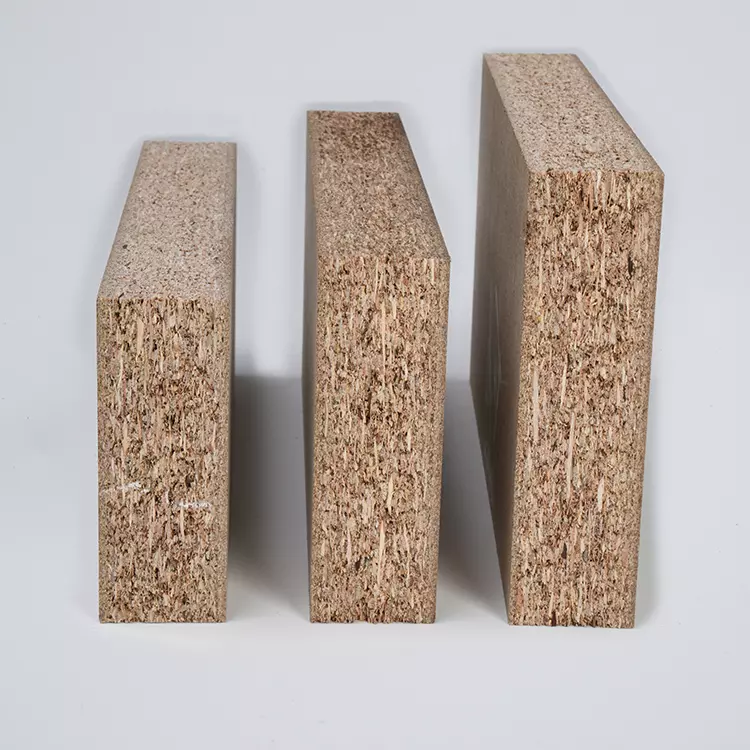
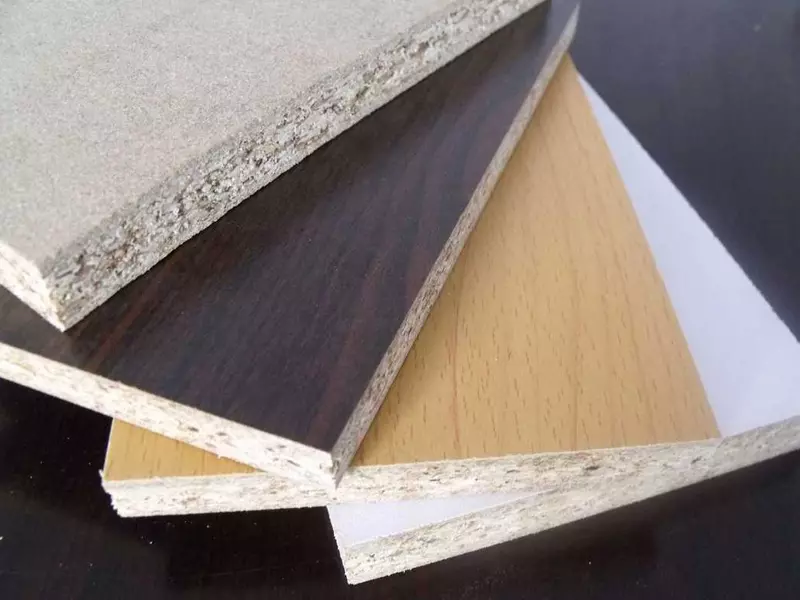
Particle board is manufactured by compressing mixed wood chips, shavings, and sawdust with urea-formaldehyde resin or MDI adhesive under high temperature and high pressure. Compared with solid wood and plywood, its structural characteristics bring inevitable weaknesses:
A. Uneven layered structure: Standard production adopts a fine-particle surface layer and coarse-chip core layer. The dense surface features high hardness, while the loose core layer has poor toughness, forming inherent density differences inside the board.
B. Residual internal stress: During high-temperature and high-pressure pressing, the board is forcibly shaped. Residual stress remains inside after cooling, keeping the board in an unstable balanced state.
C. Inconsistent water absorption: The dense surface layer is waterproof, while the porous core layer easily absorbs moisture. Temperature and humidity changes cause inconsistent expansion and contraction between the surface, core, and two sides of the board, directly resulting in warping and deformation.
In short, particle board deformation is not simply caused by poor quality, but a combined result of material properties, production techniques, and environmental changes.
2. Core Causes of Particle Board Deformation
A. Production Defects: The Biggest Hidden Danger
Low-cost and non-standard particle boards usually have hidden deformation risks from the production stage, which are common pitfalls for panel traders:
- Uneven material spreading: Uneven distribution of wood chips across the board causes inconsistent density, unbalanced stress, and inevitable side bending in later use.
- Unstable hot pressing temperature and pressure: Insufficient pressure or excessive temperature leads to incomplete curing and unrelieved internal stress; uneven temperature causes partial tight-loose differences on the board.
- Insufficient conditioning time: Qualified boards require 7–15 days of constant temperature and humidity conditioning to release internal stress. Many small factories deliver boards immediately after pressing for fast delivery, leading to gradual deformation after shipment.
- Unbalanced adhesive application: Inconsistent adhesive amount and curing speed on the two sides cause different shrinkage rates, resulting in board warpage.
B. Environmental Factors: Humidity & Temperature as Major Catalysts
Particle boards are extremely sensitive to humidity, which explains the high deformation rate during ocean freight, rainy seasons, and humid warehouse storage:
- One-sided moisture absorption: When one side of the board touches damp floors or walls while the other side stays ventilated, uneven water absorption causes immediate warping.
- Sudden temperature and humidity changes: Boards transferred from dry warehouses to humid workshops or sealed container environments produce unbalanced expansion and contraction, triggering stress release and deformation.
- Alternating high and low temperatures: Repeated thermal expansion and contraction under summer high heat and winter low temperatures gradually releases residual internal stress and causes slow deformation.
C. Improper Storage, Transportation & Processing Operations
Even qualified boards can be damaged by irregular logistics and processing, which are key control points for trading companies:
- Non-standard stacking: Inclined placement, vertical single-board storage, uneven stacking, and uneven pallet support lead to long-term unbalanced stress and deformation.
- No re-conditioning after cutting: Complete boards maintain stable stress balance, while cutting breaks the balance. Direct processing without resting causes high deformation risk.
- Unbalanced veneering process: Asymmetric veneer thickness, pressure, or temperature on both sides pulls the board and causes bending.
- Inadequate ocean freight protection: Sealed containers feature high humidity and temperature differences. Boards without moisture-proof film and desiccants easily absorb moisture and deform.
3. Two Common Types of Deformation & Root Causes
A. Arched side bending (left-right curvature): Mainly caused by uneven production spreading, inconsistent board density, or inclined stacking stress.
B. Warped bow deformation (up-down bulging): 90% caused by unbalanced humidity, one-sided moisture absorption, asymmetric internal stress, and insufficient factory conditioning.
4. Practical Solutions: How to Avoid Particle Board Deformation
Below is a fully implementable quality control solution covering procurement, warehousing, processing and shipment, suitable for domestic sales and European & American exports with CARB/EPA and FSC compliance requirements:
A. Source Quality Control (Most Critical)
- Cooperate only with formal manufacturers with standardized production and complete conditioning processes to ensure stable internal stress control.
- Prioritize export-compliant boards with valid CARB P2 / EPA TSCA Title VI formaldehyde compliance and FSC CoC certification. Compliant boards feature stricter production standards and lower deformation rates while meeting customs clearance requirements.
- Conduct pre-shipment sampling inspection: check flatness, uniform thickness, and compact board surface, and request batch test reports from suppliers.
B. Standardized Warehouse Management
- Keep warehouses ventilated and dry. Place boards on flat pallets to avoid direct contact with damp ground and walls.
- Prohibit vertical or inclined placement. Stack boards flat with uniform height to avoid partial heavy pressure.
- Fully wrap boards with moisture-proof film and place desiccants during rainy seasons and ocean freight preparation to prevent moisture absorption.
C. Standardized Processing & Shipment
- Allow cut boards to rest and re-condition for 24–48 hours to restore stress balance before veneering, edge banding and assembly.
- Ensure symmetrical veneering parameters (thickness, pressure, temperature) on both sides to avoid asymmetric pulling deformation.
- Stack and fix boards tightly during container loading to prevent squeezing and deformation during ocean transportation.
D. After-sales Risk Prevention
- Take photos to record board flatness and packaging details before shipment, and establish complete traceability files.
- Inform overseas clients of standard container unpacking and board storage guidelines for high-humidity shipping routes to reduce terminal quality complaints.
5. Conclusion: Deformation Is Controllable (Not Eliminable)
Due to structural and process limitations, 100% zero deformation cannot be achieved for engineered particle boards. However, strict source selection, standardized warehousing, and standardized processing & logistics can control the deformation rate within an extremely low range.
For trading enterprises, particle board deformation is not only a quality issue but also a key part of compliance risk control, cost management, and brand reputation building. Especially for European and American export businesses, compliant boards plus standardized quality control procedures fundamentally avoid returns, deductions, and regulatory penalties.